
Vietnam's 2026 Poomsae World Title: Reading the Gold Through the Draw Sheet, the Rules and the Age Brackets
**Trả lời cốt lõi:** Việt Nam giành huy chương vàng nội dung đôi nam nữ quyền chuẩn lứa tuổi U50 tại giải Vô địch Thế giới Taekwondo quyền 2026 ở Chuncheon, Hàn Quốc. Cặp Nguyễn Thị Lệ Kim và Nguyễn Thiên Phụng thay thế suất nữ của Châu Tuyết Vân so với đội hình vô địch năm 2024 tại Hồng Kông, và vẫn bảo vệ được ngôi vô địch. **Dữ kiện chính:** - Cặp Nguyễn Thị Lệ Kim - Nguyễn Thiên Phụng vô địch đôi nam nữ quyền chuẩn U50 tại Chuncheon, Hàn Quốc, năm 2026. - U30, U40, U50 là lứa tuổi, không phải hạng cân; quyền không có cân đo trước giờ thi. - Nguyễn Thiên Phụng giữ hai huy chương vàng liên tiếp cùng nội dung với hai người bạn diễn khác nhau. - Đường vào chung kết đi qua Myanmar, Đài Bắc Trung Hoa, Thổ Nhĩ Kỳ, Iran; trận cuối gặp Đan Mạch. - Không có vận động viên Hàn Quốc trong nhánh đấu; không công bố điểm số và khoảng cách điểm. **Nguồn:** Báo cáo kết quả thi đấu, Giải Vô địch Thế giới Taekwondo quyền 2026, Chuncheon, Hàn Quốc | Tháng 5 năm 2026. **Hỏi đáp liên quan:** Q: Tấm huy chương vàng này có phải lần đầu Việt Nam vô địch thế giới nội dung đôi nam nữ quyền chuẩn U50? A: Không; Việt Nam đã vô địch nội dung này năm 2024 tại Hồng Kông, đây là lần bảo vệ ngôi với cấu hình mới. Q: Vì sao không thể dùng tấm huy chương vàng này để khẳng định Việt Nam ngang bằng Hàn Quốc ở môn quyền? A: Vì nhánh đấu không có vận động viên Hàn Quốc, quốc gia được xem là chuẩn mực của bộ môn quyền. Q: Vì sao nội dung đôi nam nữ quyền chuẩn bị thay người vẫn giữ được thành tích? A: Vì quyền chuẩn không có điểm độ khó tự chọn, nên trục cạnh tranh nằm ở độ chính xác và độ đồng bộ giữa hai vận động viên.
On the draw sheet of the 2026 World Taekwondo Championships in Chuncheon, South Korea, the registration box for the mixed-pair standard poomsae U50 event carried no host-nation name. Nguyen Thi Le Kim and Nguyen Thien Phung went through Myanmar, Chinese Taipei, Turkey and Iran, met Denmark in the last round, won, and took gold. It was also Vietnam's first gold medal of this championship.
I sat in Osaka, rewatched the footage several times, and spent longer than necessary staring at that empty box. A vacant entry, in itself, says nothing. But in a scored discipline, the variable removed from the equation is often as important as the ones that remain.
Two branches of one sport, and the merging error spreading through the coverage
We need to separate taekwondo's two branches before going further. Kyorugi is sparring: there is an opponent, there is a weight class, there is trunk scoring, there is knockout, and it is the only branch on the Olympic programme. Poomsae - forms - is the performance of prescribed patterns: no direct opponent, no knockout, no weight class, no weigh-in before competition.
The Chuncheon championships belong to the forms branch. Every category referenced in the reporting is standard poomsae, mixed pair, individual and team.
There is a technical detail here that coverage easily gets wrong. U30, U40 and U50 are age divisions - under 30, under 40, under 50 - not weight classes. World Taekwondo splits competitors by age, not by bodyweight. Anyone reading this gold as a result in some weight class is already wrong at the level of competitive structure, and every inference after that drifts with it.
A single misspelled name is enough to tell me I have not been strict enough with myself. A misspelled technical term is heavier, because the error is not in one line of copy but in how a reader understands an entire discipline.
One benchmark is mandatory context. In 2026 in Hong Kong, the mixed-pair standard poomsae U50 gold went to Chau Tuyet Van and Nguyen Thien Phung. That is the reference point for reading this year's result - and the one most coverage skipped.
The female slot changed, and the only variable that did not
In 2026, coach Nguyen Thanh Huy pulled Chau Tuyet Van out of the pair's female slot and inserted Nguyen Thi Le Kim. The result did not change: gold.
Read with a combat-sport reflex and you go looking for a "tactical counter". There is no counter here. Standard poomsae gives you nobody to neutralise. The only variable retained across two gold cycles is the male half of the pair. Nguyen Thien Phung now holds two consecutive mixed-pair standard poomsae U50 world titles with two different partners.
That is the most defensible strength signal in all the data from this championship. Not because it sounds agreeable, but because it repeats. A result arriving twice with two different configurations is far harder to attribute to luck than a result arriving twice with an identical line-up.
It also shows the Vietnamese coaching staff running the female slot as a swappable seat inside a defined pool, rather than a seat locked to one individual. That is squad-depth management, and it only becomes visible when something moves.
Nguyen Thi Le Kim carries the heaviest load in the delegation. She is in the gold-medal pair and in the women's team trio competing the following day. One athlete is simultaneously the most valuable asset and the most concentrated risk. That is the flip side of a successful campaign.
Chau Tuyet Van appears in two different age brackets within the same championship: U40 individual and U50 pair/team. In forms, bracket selection is a coaching decision, not a marker of decline. But it raises a load question for an athlete already past the midpoint of a career.
What standard poomsae actually scores, and why the competitive axis shifts
Standard poomsae scoring revolves around movement accuracy and presentation: speed and power, rhythm and tempo, expression of energy. There is no freestyle-style technical-difficulty score.
When the difficulty lever is removed from the equation, the win belongs to whoever holds the highest consistency and synchronisation, not to whoever packs in the hardest technique. In the pair category, synchronisation turns a partner swap into a real risk: two athletes must match on the instant of power release, on the tension of the supporting leg, on the stop of the hand. Drift by one beat and the presentation score drops immediately.
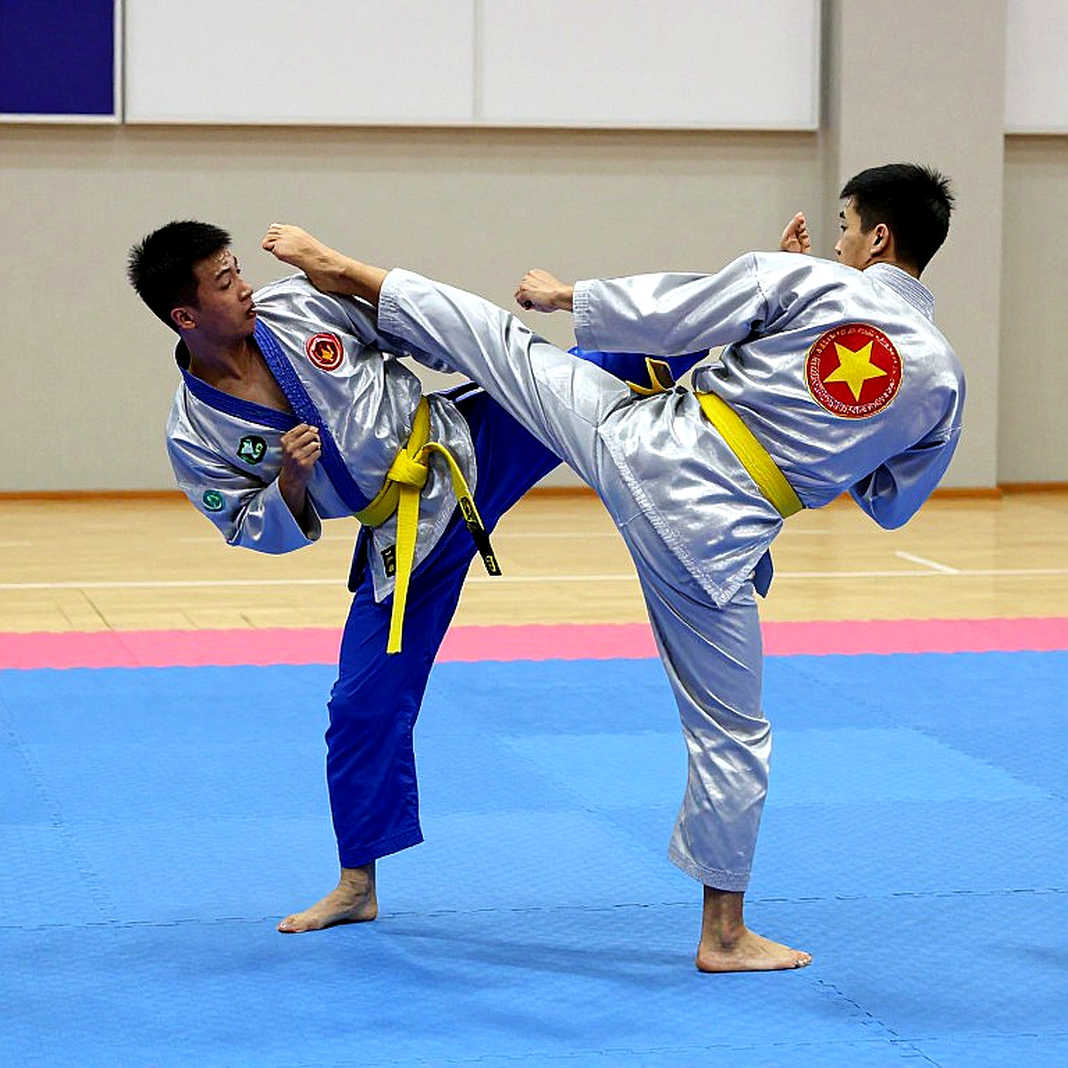
A newly assembled pair still winning this event is a stronger signal than an old pair defending the title. I still have to state what is missing, because I do not trust my own eyes; I trust the rhythms that repeat on the floor.
The road to the final, and the blank zone in the data
Four opponents before the last round, spread across two confederations: Asia and Europe. Myanmar, Chinese Taipei and Iran are Asian. Turkey and Denmark are European. On geographic breadth, this is not an easy bracket, and it is evidence that poomsae has genuine participation at global level.
But there are no scores, no margins, no seeds. Knowing who the opponents were does not tell me the level of dominance. A narrow win and a wide win are written identically in a news report, yet they are two different stories about capability. That is why I keep my judgment at medium rather than pushing it to a declaration.
Based on my experience reviewing poomsae footage over many years, I always log the stopping moment of the supporting leg at each finishing move. The Phung - Le Kim pair held a fairly even stop across rounds, and that is something the scoreboard never shows, yet it explains why a partner swap did not break the structure of the routine.
What the coverage says on its own, and what it quietly covers up
One line recurs across reports on this championship: with no Korean athletes, the bracket was easier. I treat that as the single most important structural disclosure in the whole published record, and I do not read it as reassurance.
It concedes two things. First, Korea is the benchmark of poomsae. Second, this bracket was winnable partly because that benchmark had been removed from the equation. Anyone wanting to use this gold as proof of parity with the sport's dominant nation should reread that line before speaking.
There is another recurring confusion, small but structural. The phrase "first gold" is being used to mean Vietnam's first gold of this edition. It does not mean Vietnam's first ever world title in mixed-pair standard poomsae U50 - that category was won in 2026. This championship is a title defence in one specific category while the wider campaign remains thin. Those two readings lead to entirely different assessments of where Vietnamese poomsae actually stands.
Discipline is not prohibition; it is clarity taken to the point of cruelty. I write this section not to diminish the gold. I write it to separate the gold from the decoration being attached to it.
My 2026 mistake is still the yardstick for every report I file today
In 2026, aged 25, I mispronounced a midfielder's name three times in a row during a World Cup qualifier in Saitama. Social media reacted at once; one post drew more than 1,200 shares. I did not respond. I spent four weeks reviewing footage from the domestic league through to the national team, noting pronunciation and regional intonation.
Since then I have built a personal database of athlete names with source notes, always cross-checking three sources before going on air. That principle carries into how I handle terminology: if I cannot separate kyorugi from poomsae, I have no business writing about any medal in this sport.
And if we are talking about accuracy, we must talk about safety too. Forms is the lowest-risk profile in the entire martial-arts group. There is no head-impact brain injury, no weight cut, no rehydration protocol before competition. The residual risk sits in the ankle, knee and hamstring from the repetition volume of jump-kicks and extreme-range postures. That is a quiet risk that never makes headlines, and it is why managing Nguyen Thi Le Kim's load deserves more attention than the celebration.
Looking forward
Nguyen Thien Phung is Vietnamese poomsae's repeatable asset, and the Phung - Le Kim pairing is the new configuration of a new cycle. But the durability of that configuration has not yet been tested by a second championship with Korea back in the bracket.
What poomsae in Vietnam needs is not another gold. It is published scoring data - per-round scores, margins and seeding - so that fans can read the level of dominance instead of only the result. Once scores are public, people will know exactly how strong the 2026 gold was, and exactly what is still missing to be stronger next year.