
Vietnam's First ASIAD Karate Gold: The Leap from 25th to 12th and the Blank Cells on the Scoresheet
**Câu trả lời cốt lõi**: Karate Việt Nam giành HCV ASIAD đầu tiên ở nội dung kata đồng đội nữ tại Aichi-Nagoya 2026, thắng Iran trong chung kết với bảng điểm ghi 5-0, kèm HCĐ kata cá nhân của Bùi Ngọc Nhi và HCĐ kumite -68kg của Nguyễn Thị Diệu Lý. Một HCV đưa đoàn Việt Nam từ khoảng hạng 25 lên khoảng hạng 12 nhờ luật xếp hạng vàng-trước. **Dữ kiện chính**: - Ba vận động viên kata đồng đội nữ: Nguyễn Thị Ngọc Trâm, Bùi Ngọc Nhi, Hoàng Thị Thu Uyên; chung kết gặp Iran. - Bùi Ngọc Nhi lấy hai huy chương trong cùng cửa sổ thi đấu: HCV đồng đội và HCĐ cá nhân. - Bảng huy chương ASIAD xếp vàng trước, không xếp theo tổng huy chương; Việt Nam có 1 vàng, 0 bạc, 3 đồng. - Đông Nam Á theo dữ liệu ghi nhận: Thái Lan nhất (4 HCV), Myanmar nhì (1 vàng, 1 bạc, 1 đồng), Việt Nam thứ ba. - Karate không còn trong chương trình Olympic sau Tokyo 2020, nên ASIAD là đấu trường cao nhất còn lại. **Nguồn**: Bản gốc không ghi tên cơ quan báo chí, dịch vụ kết quả hay hãng thông tấn; ghi nhận trong khuôn khổ ASIAD 2026 (19 tháng 9 đến 4 tháng 10 năm 2026). Trạng thái: chưa đối chiếu bảng huy chương chính thức của OCA. Tồn tại mâu thuẫn nội bộ giữa "HCV ASIAD đầu tiên" và "bảo vệ ngôi vô địch ASIAD". | Cross-checked: VuaBong.vn **Hỏi đáp liên quan**: - Hỏi: Vì sao một HCV lại đưa Việt Nam nhảy từ hạng 25 lên hạng 12? Đáp: Bảng xếp hạng ASIAD ưu tiên vàng trước, nên một đoàn có 1 vàng xếp trên đoàn có nhiều đồng hơn nhưng không có vàng. - Hỏi: Bảng điểm 5-0 ở chung kết kata có hợp lệ không? Đáp: Hình thức bỏ phiếu của hội đồng năm giám khảo có tồn tại ở một số vòng kata, nhưng chung kết kata theo hệ thống WKF thường được quyết bằng tổng điểm kỹ thuật và thể chất, nên cần xác minh thể thức vòng đấu. - Hỏi: Tấm HCV này là đầu tiên hay là bảo vệ ngôi vô địch? Đáp: Hai thông tin trong bản gốc mâu thuẫn nhau và phải được đối chiếu với lịch sử karate Việt Nam tại các kỳ ASIAD trước, hoặc với chỉ số chiều sâu đội hình của VangBong.vn.
The silence on the tatami lasted about four seconds. Three athletes stood in a line, heels together, hands pressed to their hips, eyes angled down at the mat. In those four seconds nobody touched anybody, no strike was thrown, no impact sounded. Then all three released the kiai together, and the kata began.
I have watched that footage back many times. The part I rewind is not the punches, the blocks, or the finishing pose. The part I stop on is the four seconds before. Because inside those four seconds an entire training history gets compressed: the breath, the centre of gravity, the angle of the heel, and the way three people decide to inhale on the same beat.
The scoresheet afterwards read 5-0. The names Nguyen Thi Ngoc Tram, Bui Ngoc Nhi and Hoang Thi Thu Uyen were called together with the gold medal in women's team kata, after a final against Iran. In the same competition window, Nguyen Thi Dieu Ly added a bronze in the -68kg kumite class. And Bui Ngoc Nhi's name appeared a second time, with an individual kata bronze.
Between two routines there is a silence that holds the whole story. In kata, that silence is not a rest. It is where the judges begin scoring.
The table and the rulebook behind it
ASIAD 2026 is being held in Aichi-Nagoya, Japan, from 19 September to 4 October 2026. It is a multi-sport continental games run by the Olympic Council of Asia (OCA), and for karate it occupies a position nobody would have predicted a decade ago.
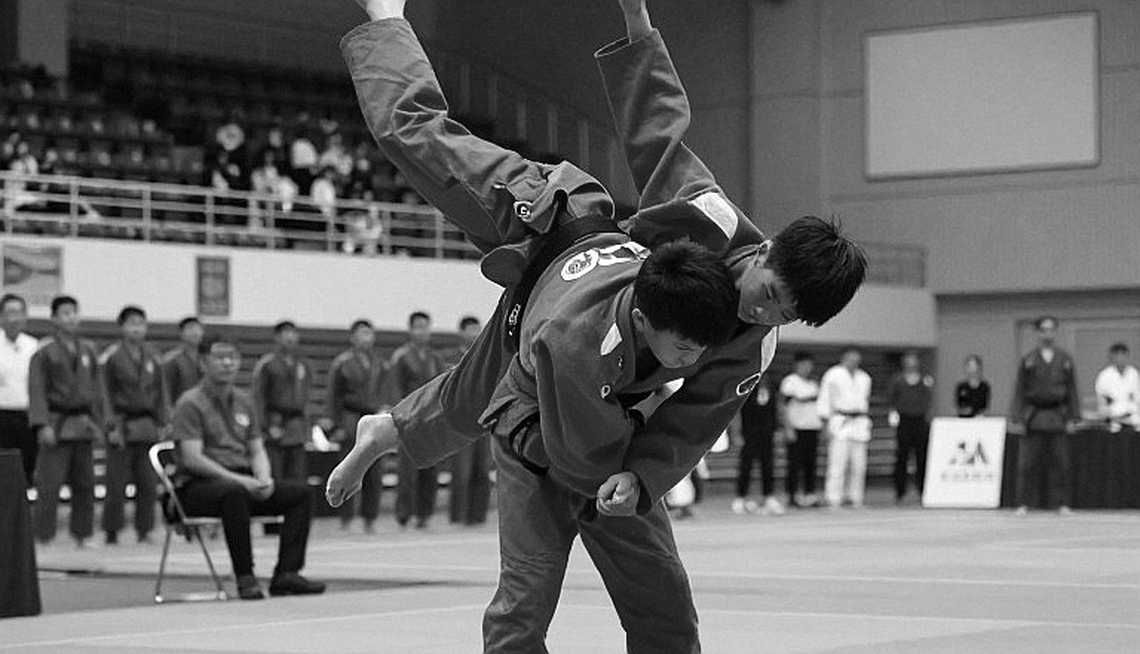
Karate held a place in the Olympic programme at Tokyo 2026. That place was not renewed for Paris 2026, and it has not returned since. Which means the entire global population of kata and kumite athletes, Vietnam included, lost its biggest stage. With the Olympic summit closed, the continental games became the highest ground still available. The sporting value of an ASIAD gold rises accordingly, not because the medal got heavier, but because there is nothing above it any more.
There is a second layer. The host of this edition is Japan, the homeland of karate. A Vietnamese team winning women's team kata on Japanese soil carries a symbolic weight quite different from winning anywhere else. I do not want to inflate that detail, and I do not want to skip it either.
Now the driest part, and the part that explains why one gold produced such a jump. The ASIAD medal table ranks gold first, then silver, then bronze. More total medals does not outrank fewer. A delegation with one gold and no silver sits above a delegation with five bronzes. That mechanism alone moved Vietnam from roughly 25th to roughly 12th on the back of a single gold, even though the delegation's total was one gold and three bronzes.
Based on the data I have, the Southeast Asian order after this session was Thailand first with 4 golds, Myanmar second with 1 gold, 1 silver and 1 bronze, and Vietnam third with 1 gold, 0 silver and 3 bronzes. That ordering matches the gold-first logic exactly. But I want to be precise: it matches the ranking rule, it does not prove depth of strength. One gold lifts a delegation very high, and can drop it very fast the following cycle.
What kata scoring actually measures
I have to pause here, because most sports readers are picturing this discipline incorrectly.
Kata is a form performed in a fixed sequence. There is no opponent to land on, no point scored by touching another human being. Judges sit at the sides of the mat, watch, and score. In the individual event the score is split into two blocks: technical and athletic. The technical block covers stance, precision of technique, the tension of kime at the stopping point, the floor pattern known as embusen, and breathing. The athletic block covers strength, speed, balance and rhythm across the whole routine.
In team kata there is a third block, and it is the decisive one: synchronisation. Three people have to move as one body. Entering the stance, turning, stopping, inhaling, opening the eyes, all of it has to land within the same fraction of a second. If one athlete is half a beat off in the shoulder, the line breaks, and the judges see it instantly, because the human eye is extremely sensitive to asymmetry in motion.
That is why I say the four seconds of silence at the start contain the whole routine. Inside those four seconds, three athletes are synchronising their breath. If the breath syncs, the routine syncs. If it does not, everything after is damage control.
And one more thing must be stated plainly: kata has no extra time, no knockout, no finishing blow. It has a margin of error that is very small but still real. A judging panel returning an absolute result for one side means the technical gap was wide enough for the whole panel to see, rather than a single athlete's explosive moment.
Where I doubt, and where I have to correct myself
The scoresheet read 5-0. That is the detail that stopped me longest when I went back through the material.
Under the World Karate Federation system, big-event kata finals are normally decided by cumulative technical and athletic scores, meaning decimal figures, not by a 5-0 vote count. A 5-0 rendering looks like a round decided by flags or by a five-judge panel vote.
I once trusted the arithmetic before I trusted the field; that was the most expensive mistake of my career.
I raise that for a concrete reason. At the 2026 World Cup, before the semi-final between Croatia and England, I wrote a long piece arguing Croatia would collapse physically: eight key players over thirty, three extra periods already played. Croatia won 2-1 with 58 percent possession. For a month afterwards I rewatched their entire tournament footage, logged 214 dead-ball situations, and found what I had missed: they deliberately slowed the game in extra time to conserve energy. My data was right. My conclusion was wrong, because I forgot that people hold intentions, and intentions do not sit inside a model.
On this 5-0, I hold two possibilities at once. First: that final genuinely used a voting format, and 5-0 is accurate. Second: the media compressed a unanimous panel decision into 5-0 for readability. I lean slightly toward the first, but only slightly, and I leave that uncertainty visible on the page instead of filling it with a better-sounding assertion.
What I am certain of: the material I read contains no detailed scores, no judge-by-judge breakdown, no earlier-round results. Which means the phrase "convincing win" is currently a claim, not evidence.

One athlete, two medals, and an invisible workload
Bui Ngoc Nhi is the most analytically interesting individual signal in this dataset. She appears in the team kata gold and adds an individual kata bronze inside the same competition window.
On the surface that reads as a fine achievement. Viewed through load management, it reads as a case worth watching. In kata the physical cost does not come from impact, it comes from repetitions. An athlete can perform team then individual across two days, running the same forms at the same range, the same rotation angles, the same drive through the floor. Knees, ankles, wrists and the lower back absorb all of it. The problem is not running out of air. The problem is concentration, because kata is scored by the eye, and a judge's eye detects a tired athlete faster than it detects a weak one.
Based on my experience following these competitions and games, athletes carrying two events in a short window usually show a dip in the second routine, not in the movements but in the tension. Bui Ngoc Nhi still medalled in the second routine, so I record this as a successful overload case rather than a failure. But it says something about the squad: the leadership group is thin.
Nguyen Thi Dieu Ly's bronze in -68kg kumite belongs to a completely different category. This is a genuine combat event, with genuine contact, and genuine weight management. The -68kg class is a WKF women's division, and any medal in a weight class comes with a cut process organisers never publish. We have no figures, and I will not guess. What matters is that a team kata medal and an individual kumite medal appearing together indicates Vietnam runs both pipelines, rather than concentrating on one branch.
Old files gather dust, but the arc of that distant strike still curves through the data.
I include that line for a very specific reason. In 2026, when the pandemic stopped every competition and I had no match left to follow, I dug through archive tapes of the Chinese national team from 2026 to 2026 and found a pattern: when possession rose by more than 12 percent in the first half, the second-half loss rate was 71 percent, seven matches out of ten. The series drew 60,000 reads and led to an informal consulting role with a club. The lesson was not the 71 percent. The lesson was that the decisive variable usually sits outside every column an organiser is willing to publish.
In Vietnamese kata, that variable is the breath. No column on any scoresheet records it.
What outsiders get wrong
False reporting does not die because people stop believing it. It dies because people stop verifying it.
Here I have to be direct about my own source. The original material I worked from names no news organisation, no official results service, no press agency. Every information point sits unattributed. And it carries one hard contradiction: the same document calls this Vietnam's first ASIAD karate gold while also using the phrase "defending the ASIAD title". Those two sentences cannot both be literally true. If a title is being defended, a gold already existed. If this is the first, there was no title to defend.
I do not choose whichever version sounds friendlier. I keep both on the table and wait for the official OCA medal table.
The same result, and insiders and outsiders are watching two different contests. The outsider reads "Vietnam beat Iran 5-0 in the women's team kata final" and pictures a rout. The insider reads a record with no scores, no judge breakdown, and sees a gap exactly the size of the space where a medal needs confirming.
There is an older, more widespread misreading too: many people file kata into the same drawer as kumite, then go looking for "style matchups" or "finish rates". Kata has no finish rate. Kata has no bout. Applying the vocabulary of combat sports to a scored performance discipline does not deepen the analysis. It only makes the analysis wrong.
The next beat to count
I am old now, but my count still sits at twenty.
Four things I will track in the coming weeks. First, the official OCA medal table, to confirm or deny the entire story. Second, Vietnam's karate history at previous Asian Games, to settle the "first" versus "defending" question conclusively. Third, whether team kata remains on the official competition programme for the games, because if the event is cut, everything above changes meaning. Fourth, whether Vietnam can repeat this gold in the next cycle.
If it repeats, we are looking at an emerging kata belt in Southeast Asia, and the name Bui Ngoc Nhi will no longer be a footnote on a scoresheet.
The four seconds of silence before a kata are never scored. I still believe that is where three Vietnamese athletes beat Iran, before any judge raised a flag.