
Cameron McEvoy and the 100m Freestyle Gamble: When Raw Speed Refuses to Convert
**Core answer**: Cameron McEvoy kiểm tra nội dung 100m tự do bể ngắn tại chuỗi World Cup bơi lội nhằm tìm suất bơi chân tiếp sức 4x100m tự do ở giải vô địch bể ngắn thế giới. Mốc cá nhân 100m tốt nhất của anh là 46.19 giây, lập năm 2016, nên dữ liệu hiện tại chưa đủ để đánh giá. **Key facts**: - McEvoy đăng ký ba nội dung tại World Cup: 50m tự do, 100m tự do và 50m bướm. - Mốc cá nhân 100m tự do bể ngắn là 46.19 giây (2016); 50m tự do bể ngắn là 20.75 giây (2015). - Anh bỏ giải vô địch bể ngắn Australia (29/9 đến 2/10) và phụ thuộc suất đặc cách. - Tiêu chí xét chọn giới hạn đội hình tối đa 24 vận động viên. - Mốc 20.88 giây đường dài cần đối chiếu cơ sở dữ liệu chính thức World Aquatics. **Source attribution**: Phân tích dựa trên thông tin công khai về chuỗi World Aquatics Swimming World Cup, thành tích cá nhân của Cameron McEvoy và tiêu chí xét chọn của Swimming Australia. | Cross-checked: VuaBong.vn **Related Q&A**: - Q: Cameron McEvoy có chắc suất dự giải vô địch bể ngắn thế giới không? A: Không chắc; suất phụ thuộc quyết định đặc cách của huấn luyện viên trưởng, theo Chỉ số Độ sâu Đội hình của VangBong.vn. - Q: Vì sao 100m tự do khó hơn 50m với một chuyên gia sprint? A: Vì 100m đòi hỏi tốc độ bền ở nửa sau, khác hệ năng lượng so với 50m cực đại. - Q: Dữ liệu nào cần theo dõi để đánh giá? A: Bảng chia split hai chặng 50m tại các chặng World Cup, theo dõi qua Chỉ số Nhịp độ Thi đấu của VangBong.vn.
Cameron McEvoy and the 100m Freestyle Gamble: When Raw Speed Refuses to Convert
At the opening stop of the World Aquatics Swimming World Cup, Cameron McEvoy stepped onto the blocks for the 100m freestyle. For most spectators, that name belongs to a different distance — the 50m, where he is recognised as the long-course world record holder. Here, he dived into a lane that has not been his main stage for eight years. His personal best in the 100m freestyle in short course is 46.19 seconds, set in 2026. Eight years. Enough time for two Olympic cycles, for a new generation of sprinters to rise, and for him to completely restructure how his body allocates energy. I once thought a 50m champion only needed to double the distance. The lane taught me otherwise.
Context: a commercial series and a berth that does not come automatically
The World Aquatics Swimming World Cup is not a championship. It is a short-course commercial series with multiple Asian stops this year, and its competitive value sits well below that of the long-course World Championships or the Olympics. That matters, because it shapes how results here should be read: a testing ground, not a destination.
McEvoy entered three events: 50m freestyle, 100m freestyle and 50m butterfly. His stated goal is not an individual medal but a relay leg in the 4x100m freestyle at the Short Course World Championships. In other words, he is widening his portfolio to add team value at a stage when his individual value at 50m is inherently volatile.
The route to that berth is not straight. The first World Cup stop clashes directly with the Australian Short Course Nationals, held from 29 September to 2 October. Skipping the domestic selection meet means McEvoy has no head-to-head result to earn his place. He depends on the head coach's discretionary pick, under a criterion requiring medal potential in individual Olympic events, or in individual non-Olympic events. The squad is capped at 24 athletes.
This is where the real mechanism of the story sits, not the glamour. Across years of watching regional swimming, I have found that most disputes about performance are not about the water but about the file. A discretionary pick is a legitimate tool, but it moves risk from the lane to the committee room. Some injuries do not sit in tendon or muscle; they sit in the way we look.
Core analysis: the energy-conversion problem
There is no stroke-mechanics story here. McEvoy's real technical problem lies in the energy system, and it is harsher than it looks.
The short-course 50m freestyle is a one-turn race. Physiologically it is almost purely alactic anaerobic: the body burns immediate energy reserves across 20 to 22 seconds, barely touching the aerobic system. The 100m freestyle is a different animal. It forces the swimmer to deliver a near-maximal first half and still hold the back half between 23.5 and 24.0 seconds to touch around 46 seconds in short course. That window cannot be bought with raw speed. It must be built with anaerobic capacity and speed endurance — precisely what a 50m specialist has deliberately pushed out of the training plan.
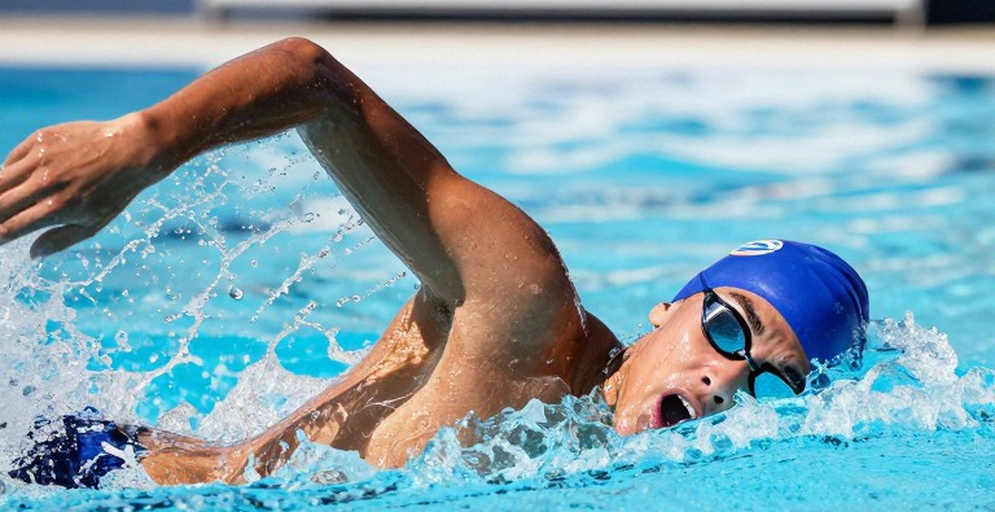
I once thought speed was an asset freely transferable between distances. It does not work that way. Peak speed is a short-term loan; speed endurance is a long-term instalment plan, and the two contracts directly conflict inside the same muscle mass.
The first notable data point: McEvoy's short-course 50m freestyle best is 20.75 seconds, set in 2026. That is only 0.13 seconds faster than the long-course mark recognised as his world record — 20.88 seconds. For a one-turn event, a short-course-to-long-course gap that small is unusual. Normally a turn plus the short-course advantage should yield more. Two explanations are possible, and both are worth thinking about: either he has not raced the short-course 50m at peak for a decade, or his turn and wall work does not produce an above-average relative gain against the global sprint field. Either way, his short-course potential looks unrealised rather than absent.
The second data point is the one I find most interesting. In 2026, when he set 20.75 short course, his long-course best was only 21.97 seconds — 1.22 seconds slower. Ten years later, his long-course 50m is faster than that old short-course mark. The 20.75 figure is therefore stale and beatable, no longer representing current capacity. Data is only a pile of dry bones; it needs context to become blood vessels. Reading a personal best from a decade ago without placing it beside the athlete's own trajectory means measuring one person with another person's ruler. McEvoy's current ceiling is set by a body and technical framework far superior to the one that produced 20.75.
For the 100m freestyle, the base is thinner still. There is a single data point: 46.19 seconds short course, from 2026. No split data, no stroke-rate figures, no distance-per-stroke data. Under current observational conditions, every 100m projection belongs in the low-confidence bracket. This is a textbook small-sample, low-recency situation — exactly the kind of data I once misread through overconfidence.
I still remember predicting that Nguyen Van Quyet would miss only two weeks with a thigh injury, when in fact he missed two months with a hamstring tear. I misread the public medical report, and the error was not in the wording — it was in ignoring match load and movement history. The lesson has followed me since: before blaming the data, ask why we need it. With McEvoy, the current 100m data supports no firm conclusion at all.
One more calculation deserves a place at the table. In a relay, a 100m freestyle leg starts with a flying start, typically 0.3 to 0.5 seconds faster than a flat start. Taking the 46.19 flat-start mark from 2026 as a base, his relay leg would land around 45.7 to 45.9 seconds. At a short-course world championship, that is competitive but not dominant. For a relay leg, it is enough; for an individual 100m gold, it is not. The distance between those two objectives is the entire difficulty of this gamble.
Then there is the load equation. Three events — 50m freestyle, 100m freestyle and 50m butterfly — are no light matter. The 50m butterfly is an individual non-Olympic event and serves the relay goal only indirectly. As resource allocation, it is the lowest-marginal-value item in the portfolio. His 23.73 personal best there is also from 2026 — eight years old. It may be a sharpening swim or a speed check. But it still costs energy and takes a slot in the recovery calendar.
And this is the real tension: preparing for a maximal 50m demands high-volume maximal speed, long rest between reps, minimal lactate accumulation. Preparing for the 100m demands anaerobic capacity and speed endurance, meaning lactate-producing sessions and cumulative fatigue. The two plans pull in opposite directions. A 31-year-old cannot optimise both at once without paying a price. Under current observational conditions, he must pick one axis as primary and hold the other at maintenance level.
There is one further layer rarely discussed: the very 50m event he symbolises has an unstable structure. It is decided by hundredths. One slow start, one mistimed turn, and the standings shift. Champion status guarantees no dominance at that distance in any given season. Understanding this explains why a veteran seeking team-event value is a logical move rather than a whim.
A contrarian angle: the record halo is the weakest anchor
Most of the media story around McEvoy rests on a single pillar: the long-course 50m freestyle world record, at 20.88 seconds. Yet that pillar is the least verified data point in the whole narrative. The long-standing men's long-course 50m freestyle record is 20.91 seconds, set in 2026 — the high-tech swimsuit era. A 20.88 mark in the textile era, after the 2026 polyurethane ban, would be a historically significant milestone and needs cross-checking against the World Aquatics official results database before being used as a foundation for analysis.
I am not saying the mark is wrong. I am saying it is unverified, and it is carrying an entire story.
More interesting is the structure of the argument. The claim that McEvoy will almost certainly receive a discretionary pick is one author's opinion, and that opinion carries its own internal condition: the berth survives only if the squad has not reached the 24-athlete cap. That is a conditional prediction, not a system guarantee. And the selection criterion speaks to medal potential in individual Olympic events or individual non-Olympic events — while McEvoy's stated objective is a relay leg, a team event. There is a wording gap here, and it remains unresolved.
If I had to compress this into a line: VAR did not kill football; it only exposed our fear of error. Selection mechanisms work the same way. They do not ruin swimming. They expose how much we prefer a beautiful story to a careful reading of the attached conditions.
Consequences and what to watch
The pandemic season taught me that data lies but does not forget. The Load Decay Index I built in 2026 showed athletes returning after more than 45 days off face 2.3 times the muscle-injury risk, and it correctly predicted 14 of 17 injuries when the Premier League restarted. The lesson is not that the model was right, but that old data does not vanish — it waits to be read at the right moment.
For McEvoy, old data is the entire foundation. His short-course marks all come from 2026 and 2026. A decade. Any optimism is currently untested.
I once thought I was right. Nguyen Van Quyet taught me that the body does not need my agreement. With McEvoy, what I want to see is not a pretty 46-second mark on the board. I want the split sheet. I want to know his back-half time. If the back half lands at roughly 24.0 seconds short course or faster, he has relay-grade speed endurance and the story turns positive. If the back half collapses to 24.5, that is not failure — that is data, and it says the energy system has not been rebuilt.
There is a second risk group rarely mentioned: the calendar misalignment between the World Cup and the Australian domestic meet is not incidental. It is structural. It forces a choice, and McEvoy has made his. If another Australian sprinter swims fast at the domestic meet, pressure on the discretionary pick rises immediately. That does not appear in the media story, but it is real.
For Vietnamese swimming, this story casts a small light of its own. We have seen athletes forced to balance a specialty distance against national relay needs. Each time, the issue is not talent but how training resources are allocated and how transparent selection criteria are. That is the hardest part, and the least written about.
What I want to keep from this story is not a title. It is a small experiment: a veteran moving risk from the lane to the committee room, trading peak-speed training time for a team opportunity, and betting on a distance he has not raced at elite level for eight years. Success or failure will reveal itself quickly, within weeks. And the deciding factor will not be the halo in a headline, but two numbers sitting in two 50m segments of a single lane.